
This project is a collaboration of Mexico ¿cómo vamos?, Ansley Consultores Internacionales, and Connecting Mexico.
USMCA and U.S. Economic Security
Six infographics on how North American integration strengthens food security, logistics, co-production, advanced manufacturing, and technology resilience.
The United States, Mexico, and Canada are not just trading partners. They are a deeply integrated production platform. Through USMCA, North America has the rules, scale, and complementarities needed to strengthen supply chains, reduce strategic dependencies, and compete in a more fragmented global economy.

Why USMCA matters now
USMCA gives North America a shared framework for trade, investment, rules of origin, labor standards, and regulatory certainty. In a world of geopolitical disruption, these rules help keep supply chains closer to final markets and support U.S. economic security.
USMCA is the institutional backbone of North American competitiveness.
- Trade scale and investment certainty
- Regional economic weight
- 2026 Joint Review context

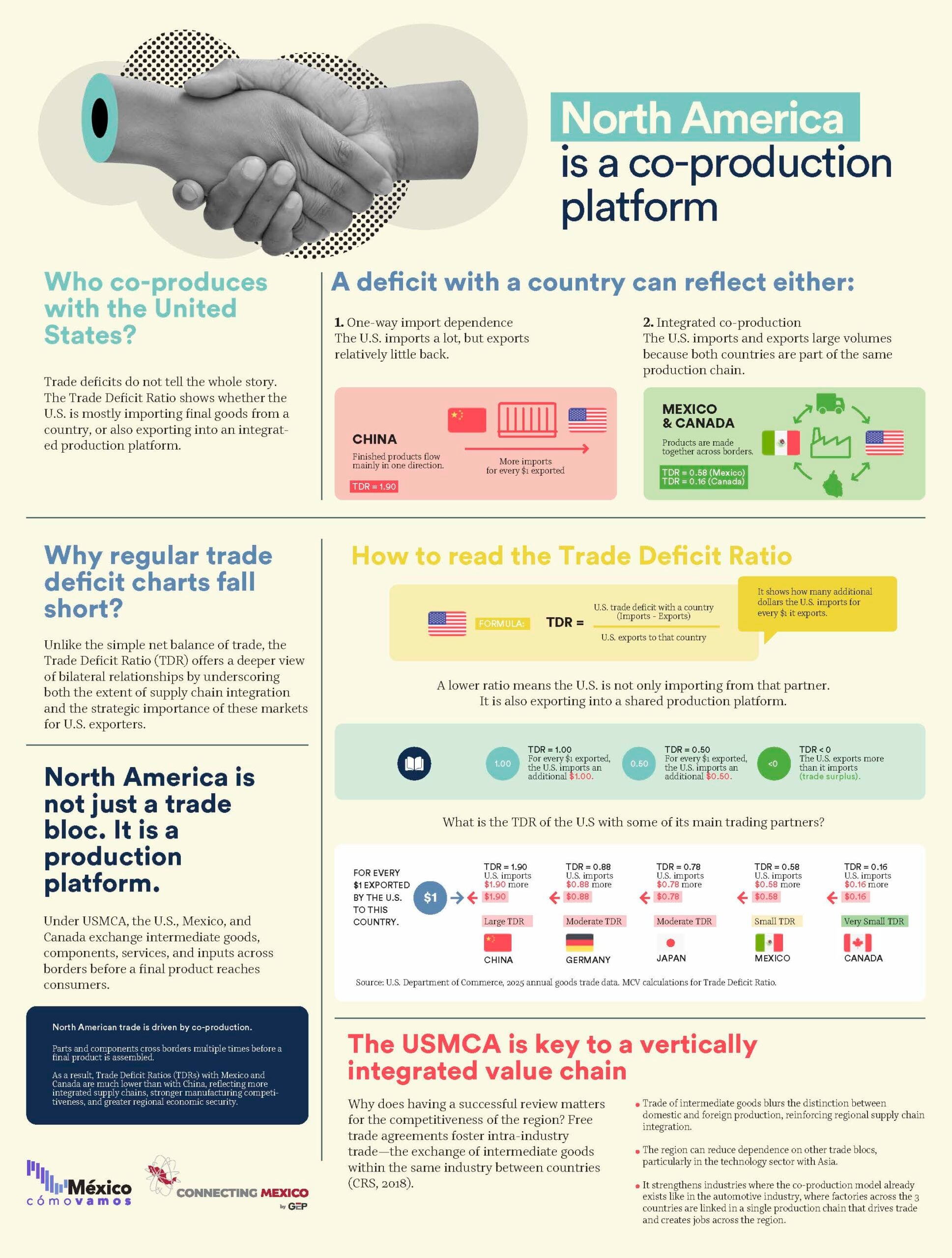
North America is not just a trade bloc. It is a production platform.
North America's strength lies in co-production. Goods are not simply made in one country and sold in another. Inputs, components, services, data, and logistics move across borders as part of a single regional production system.
Trade with Mexico and Canada reflects shared production, not one-way dependence.
- Integrated production platforms
- Intermediate goods and shared value chains
- Why disruptions ripple across the region
One market, with food security built on complementarities
Food security in North America depends on regional trade. Mexico, the United States, and Canada supply each other with complementary products, helping stabilize availability, reduce seasonal shortages, and support producers and consumers across the region.
USMCA helps keep North American food systems supplied, diversified, and resilient.
- Complementary agricultural trade
- Year-round availability of fruits and vegetables
- U.S. producers and consumers benefit from regional trade

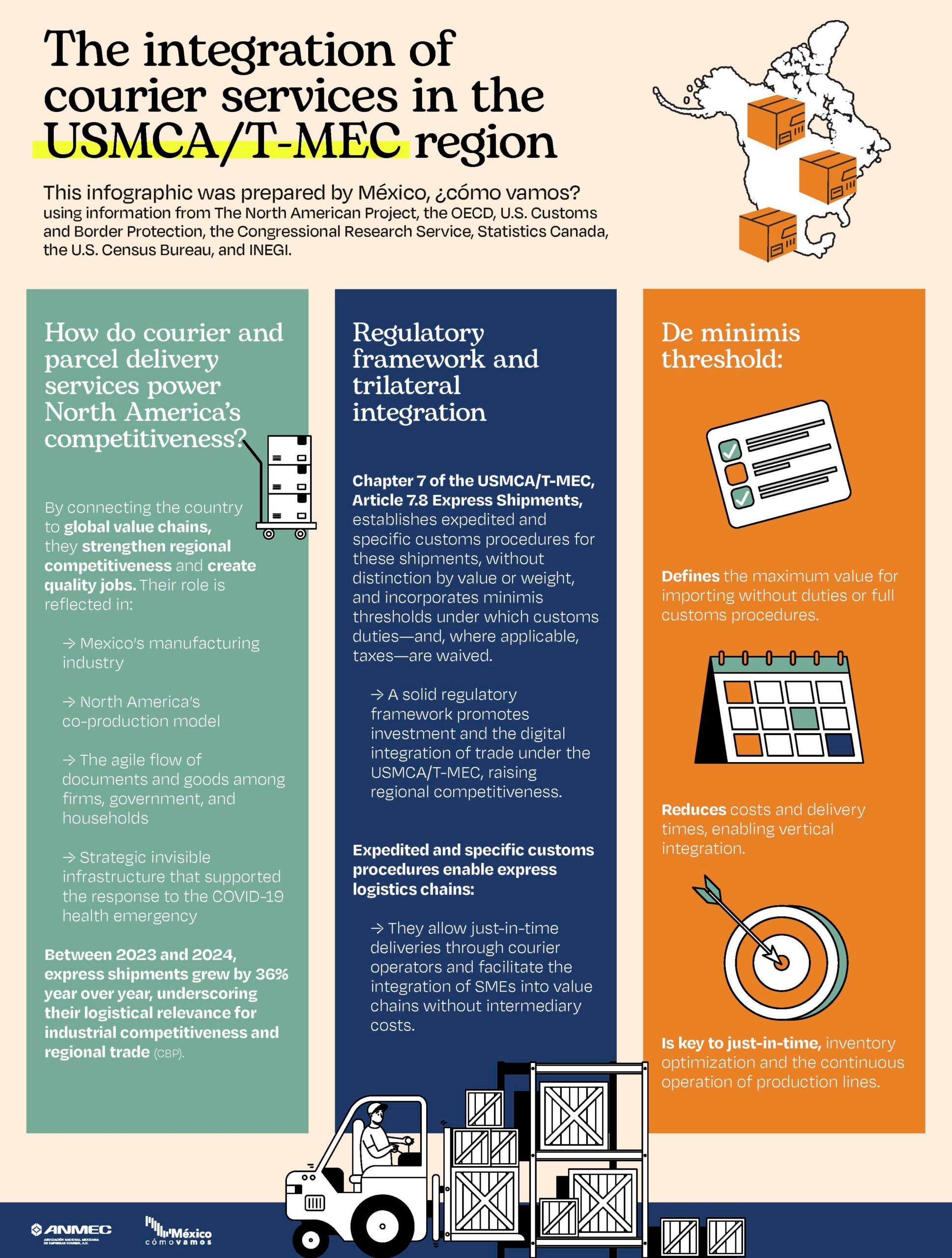
The logistics layer behind North American co-production
Fast, traceable, and reliable logistics are essential for North American production. Courier and parcel delivery services move intermediate goods, documents, components, and high-value inputs across borders, supporting just-in-time operations and regional supply chains.
Courier services are intangible infrastructure for North American competitiveness.
- USMCA Chapter 7, Article 7.8 on express shipments
- Just-in-time logistics
- Technology, automotive, aerospace, and semiconductor supply chains
North America's most integrated value chain
The automotive industry shows how deeply integrated North American production has become. Vehicles assembled in the region depend on parts, components, workers, suppliers, and logistics networks across all three countries.
In autos, section 232 tariffs do not affect one country. They affect the whole production platform.
- Auto parts can cross borders several times
- Regional content and shared suppliers
- Tariffs act as a tax on co-production

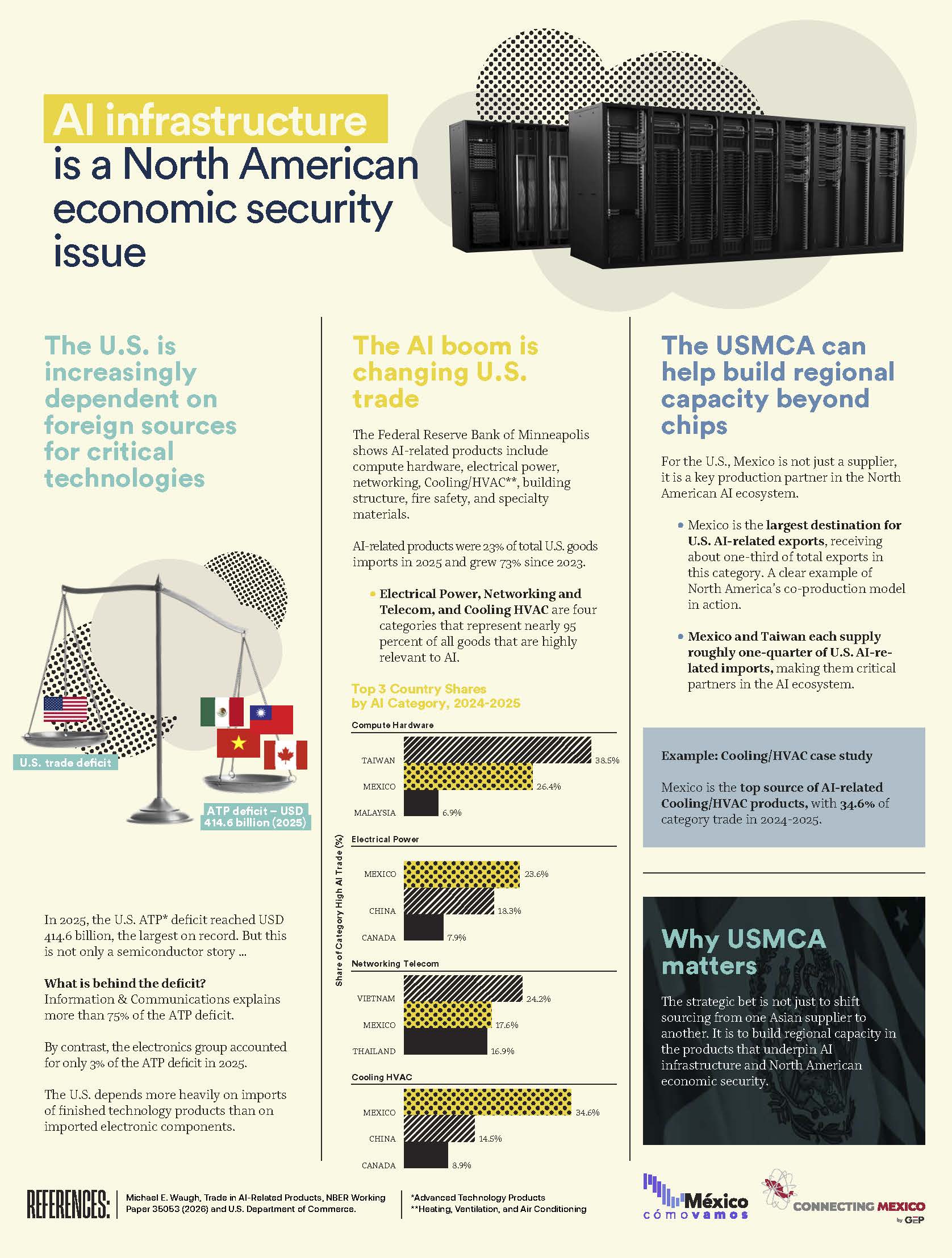
Technology resilience is economic security
The next stage of North American integration must focus on technology. The United States remains highly dependent on Asia for advanced technology products, especially information and communications goods, semiconductors, and electronic components.
USMCA can help North America build technology capacity closer to home.
- Advanced Technology Products deficit
- Asia concentration in critical inputs
- Opportunity to deepen computer and electronics co-production
Download the full deck
Access all six infographics on USMCA and U.S. economic security in one package — Fast Facts, Co-production, Agribusiness, Courier, Light Vehicles, and Advanced Technology Products.
Download PDFWhy this matters for the United States
USMCA matters because U.S. economic security depends on reliable partners, resilient supply chains, and regional production capacity. North America already has the scale, energy base, labor force, industrial capacity, and institutional framework to compete globally.
The challenge now is to deepen integration where it matters most: food, logistics, autos, technology, critical inputs, and advanced manufacturing.
A stronger North America makes the United States more secure, more competitive, and more resilient.